Table of Contents
Market Value at Risk
150+ Billion USD
Critical Timeline
2027 (Optimistic Estimate)
Quantum Speedup Factor
2-4x (Proof-of-Work)
1.1 Introduction to Quantum Threats
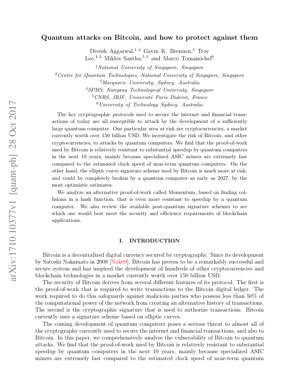
Quantum computers pose an existential threat to current cryptographic systems securing Bitcoin and other cryptocurrencies. The development of sufficiently large quantum computers could break the elliptic curve digital signature algorithm (ECDSA) used in Bitcoin, potentially as early as 2027 according to optimistic estimates.
1.2 Bitcoin Security Fundamentals
Bitcoin's security relies on two main components: proof-of-work consensus mechanism and elliptic curve cryptography for transaction authorization. The decentralized nature of Bitcoin has proven remarkably resilient against classical computing attacks since its inception in 2008.
2. Quantum Attack Analysis
2.1 Proof-of-Work Resistance
Bitcoin's SHA-256 based proof-of-work demonstrates relative resistance to quantum speedup. Current ASIC miners achieve hash rates of ~100 TH/s, while near-term quantum computers are estimated to reach clock speeds of only 100 MHz-1 GHz. The quantum speedup for Grover's algorithm applied to mining provides only a quadratic advantage, resulting in approximately 2-4x improvement rather than exponential gains.
Quantum Mining Complexity
Grover's algorithm provides: $O(\sqrt{N})$ vs classical $O(N)$
Where $N = 2^{256}$ for SHA-256, giving practical speedup of ~$2^{128}$ operations
2.2 Elliptic Curve Vulnerability
The elliptic curve signature scheme used in Bitcoin is highly vulnerable to Shor's algorithm, which can solve the elliptic curve discrete logarithm problem in polynomial time. The critical attack window exists between transaction broadcasting and blockchain confirmation (typically 10 minutes).
Experimental Timeline Projection
Based on current quantum computing development trajectories:
- 2027: Optimistic estimate for breaking ECDSA in <10 minutes
- 2030+: Conservative estimate for practical attacks
- Required qubits: ~1,500-2,000 logical qubits
3. Quantum-Resistant Solutions
3.1 Momentum Proof-of-Work
Momentum proof-of-work, based on finding hash collisions, offers enhanced quantum resistance compared to Bitcoin's SHA-256 mining. The birthday paradox provides natural resistance with only $O(2^{n/3})$ quantum advantage vs $O(2^{n/2})$ classical.
Momentum Mining Pseudocode
function momentum_mining(difficulty):
    while True:
        nonce1 = random()
        nonce2 = random()
        hash1 = sha256(block_header + nonce1)
        hash2 = sha256(block_header + nonce2)
        if hamming_distance(hash1, hash2) < difficulty:
            return (nonce1, nonce2)
3.2 Post-Quantum Signature Schemes
Several post-quantum signature schemes show promise for blockchain applications:
- Hash-based signatures: SPHINCS+ and XMSS provide strong security proofs
- Lattice-based: Dilithium and Falcon offer good performance characteristics
- Code-based: Classic McEliece provides conservative security
Key Insights
- Proof-of-work shows surprising quantum resistance due to ASIC efficiency
- Signature schemes represent the critical vulnerability point
- Transition planning must begin years before quantum computers reach critical capability
- Hybrid approaches may provide the safest migration path
4. Technical Implementation
The mathematical foundation for quantum attacks relies on Shor's algorithm for discrete logarithms. For elliptic curve $E$ over finite field $F_p$ with generator point $G$, public key $P = kG$, Shor's algorithm finds private key $k$ by solving:
$k = \log_G P$ in $E(F_p)$
The quantum Fourier transform enables efficient period finding in the hidden subgroup problem, providing exponential speedup over classical algorithms.
5. Future Applications
The transition to quantum-resistant cryptocurrencies will likely follow several paths:
- Short-term (2023-2027): Research and standardization of post-quantum algorithms
- Medium-term (2027-2035): Implementation of hybrid signature schemes
- Long-term (2035+): Full migration to quantum-resistant protocols
Emerging technologies like quantum blockchain and quantum-secure distributed ledgers may leverage quantum entanglement for enhanced security, as explored in recent research from the National Institute of Standards and Technology (NIST) post-quantum cryptography standardization process.
Original Analysis: Quantum Threat Landscape and Mitigation Strategies
The analysis by Aggarwal et al. presents a comprehensive assessment of Bitcoin's vulnerability to quantum attacks, highlighting the asymmetric risk profile between proof-of-work mining and digital signatures. This dichotomy is particularly insightful—while mining's energy-intensive nature often draws criticism, its relative quantum resistance emerges as an unexpected strength. The paper's timeline projections align with recent developments in quantum computing, such as IBM's 2023 announcement of their 1,121-qubit Condor processor and roadmap toward practical quantum advantage.
Compared to classical cryptographic attacks, quantum threats represent a paradigm shift. As noted in the NIST Post-Quantum Cryptography Standardization project, the migration to quantum-resistant algorithms requires careful planning and extensive testing. The Momentum proof-of-work alternative proposed in the paper offers intriguing properties, but its practical implementation would face significant network effects and adoption challenges similar to other Bitcoin improvement proposals.
The most critical insight concerns the attack window for transaction interception. Unlike traditional systems where key compromise has limited temporal impact, Bitcoin's transparent ledger creates permanent vulnerability for unspent transaction outputs. This necessitates urgent development of post-quantum solutions, with lattice-based cryptography showing particular promise due to its balance of security and efficiency, as demonstrated in the CRYSTALS-Dilithium scheme selected for NIST standardization.
Future research directions should explore hybrid approaches that combine classical and post-quantum cryptography, similar to the dual signature strategy employed in Google's experiments with post-quantum TLS. The blockchain community must also consider governance models for coordinated protocol upgrades, learning from previous hard forks while accounting for the unique urgency of quantum threats.
6. References
- Aggarwal, D., et al. "Quantum attacks on Bitcoin, and how to protect against them." arXiv:1710.10377 (2017).
- Shor, P. W. "Polynomial-Time Algorithms for Prime Factorization and Discrete Logarithms on a Quantum Computer." SIAM Journal on Computing 26.5 (1997): 1484-1509.
- NIST. "Post-Quantum Cryptography Standardization." National Institute of Standards and Technology (2022).
- Nakamoto, S. "Bitcoin: A Peer-to-Peer Electronic Cash System." (2008).
- Bernstein, D. J., et al. "SPHINCS: practical stateless hash-based signatures." EUROCRYPT 2015.
- Alagic, G., et al. "Status report on the second round of the NIST post-quantum cryptography standardization process." NIST IR 8309 (2020).
Conclusion
Quantum computing presents significant but manageable risks to Bitcoin and cryptocurrency ecosystems. While proof-of-work demonstrates unexpected resilience, the urgent need for post-quantum signature schemes cannot be overstated. A coordinated, phased migration to quantum-resistant cryptography, beginning with hybrid approaches and culminating in fully secure systems, represents the most prudent path forward for maintaining blockchain security in the quantum era.